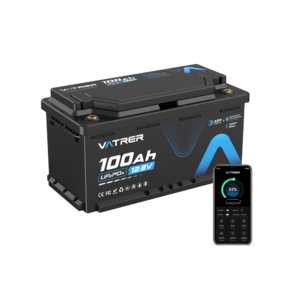
What battery does a campervan need? Capacity sizing guide
 Spaziou

Spaziou · Power · Technical guide
What battery does a campervan need? Capacity sizing guide
Choosing the right campervan battery is a key decision when improving electrical independence. A battery that is too small can run out quickly, while excess capacity can add unnecessary weight, cost and complexity.
The key is not simply to find the battery with the most amp-hours. First, understand how much energy you use each day, how long you want to stay without connecting to mains electricity and which systems your campervan has installed.
In this guide from Spaziou we explain how to calculate the battery a campervan needs, the difference between Ah and Wh, when LiFePO4 is useful, suitable capacities for different travel profiles and what else to check before buying.
What does a campervan leisure battery do?
The leisure battery stores energy for use when the vehicle is parked and no external electricity connection is available.
It can power various items in your campervan, such as:
- Lighting.
- Fridge.
- Mobile phones.
- Computers.
- Tablets.
- Water pump.
- Fans.
- Television.
- Routers.
- Other electrical devices.
The battery does not generate electricity itself. It simply stores energy for later use.
For good off-grid performance, the battery should form part of a system that may also include solar panels, alternator charging through a suitable charger, a mains charger or a power station.
How many Ah does a campervan need?
There is no universal capacity for every campervan.
An installation with 50 Ah may suffice for some very basic uses, while a campervan used for several days without external power may need 100 Ah, 200 Ah or even more.
What matters is calculating actual consumption.
As a general guide, typical usage profiles include:
- 50 Ah: very simple installations with low consumption.
- 100 Ah: a common capacity for campervans with moderate consumption.
- 150 Ah: useful when daily consumption increases.
- 200 Ah: suitable for systems needing longer off-grid time.
- 300 Ah or more: may suit high-consumption systems and extended trips.
These figures are indicative only. The right capacity depends on consumption, battery type, installation and desired off-grid time.
Ah and Wh: what do they mean?
One early question when researching campervan batteries is capacity expressed in amp-hours, or Ah.
However, when comparing different systems, it can be more useful to think in watt-hours (Wh).
The basic relationship is:
Wh = V × Ah
For example, a 12 V, 100 Ah battery has a nominal capacity of:
12 × 100 = 1,200 Wh
In other words, around 1.2 kWh of nominal energy.
This does not mean you can use the full 1,200 Wh. Usable energy depends on battery chemistry, depth of discharge, system efficiency and other factors.
How much energy does a campervan use per day?
First estimate daily consumption to calculate the battery you need.
A simple method is to list all electrical devices and estimate their daily operating time.
The basic formula is:
Daily energy use = power × hours of use
For example, if a device uses 20 W and runs for 5 hours:
20 W × 5 h = 100 Wh
Repeat this calculation for all devices to estimate daily consumption.
Example daily energy use in a campervan
Imagine a campervan used by two people with moderate consumption.
| Device | Estimated consumption | Daily use | Daily energy |
|---|---|---|---|
| Refrigerator | 45 W | 8 equivalent hours | 360 Wh |
| LED lighting | 10 W | 4 h | 40 Wh |
| Mobile phones | 20 W | 2 h | 40 Wh |
| Computer | 60 W | 3 h | 180 Wh |
| Water pump | 60 W | 0.5 h | 30 Wh |
In this example we would have approximately 650 Wh per day.
Remember that this is only an example. A fridge does not necessarily draw its maximum power throughout operation, and actual consumption can vary greatly with model, outside temperature and use.
How to calculate the battery capacity you need
Once daily consumption is known, we can make an initial estimate.
Suppose you consume around 600 Wh per day and want enough energy for two days without recharging.
You would need approximately:
600 Wh × 2 days = 1,200 Wh
We must then account for the fact that the battery's full nominal capacity may not be available for use.
The actual calculation must account for battery technology and the reserve you want to retain.
Which battery is best for a campervan?
Several leisure battery technologies are currently available.
Common types include:
- Lead-acid batteries.
- AGM batteries.
- Gel batteries.
- LiFePO4 lithium batteries.
Each technology differs in weight, usable capacity, maintenance, charge cycles, price and operating behaviour.
AGM batteries for campervans
AGM batteries have been widely used in leisure battery installations for many years.
Its main appeal is often availability and a potentially lower initial cost than some lithium batteries.
They have limitations compared with lithium technologies, especially when seeking lower weight or routinely using more of the nominal capacity.
LiFePO4 batteries for campers
LiFePO4 batteries, also called lithium iron phosphate batteries, have become a strong option for many campervan installations.
Key benefits include:
- Lower weight for comparable capacity.
- High usable capacity.
- Good service life when used correctly.
- Higher efficiency in certain applications.
- High capacity without adding as much weight.
A LiFePO4 battery also requires checking installation compatibility, especially the charging system and temperature conditions.
That is why we should not buy a battery simply because its capacity is high.
Is 100 Ah lithium equivalent to 100 Ah AGM?
Not necessarily in terms of usable energy.
Even if both batteries are rated at 100 Ah, the energy you can regularly use may differ.
This is one reason why comparing batteries by Ah alone can be misleading.
Also account for voltage, recommended depth of discharge, efficiency and manufacturer-specific characteristics.
How long does a 100 Ah battery last in a campervan?
It depends entirely on consumption.
A 100 Ah battery at 12 V has around 1,200 Wh nominal capacity.
At 300 Wh daily consumption, you would theoretically have several hours of use before exhausting the available energy.
At 1,000 Wh daily consumption, off-grid time would be much shorter.
The right question is therefore not simply how long a 100 Ah battery lasts, but:
How much do you use daily, and what proportion of the battery can you use?
How long does a 200 Ah battery last?
A 200 Ah battery at 12 V has roughly twice the nominal capacity of a 100 Ah battery.
Again, actual runtime depends on consumption.
At 500 Wh daily consumption, a 200 Ah battery offers a very different off-grid time than for someone using 1,500 Wh per day.
We therefore always recommend calculating consumption first.
Do you need 100 Ah or 200 Ah?
This is one of the most common decisions.
100 Ah may be enough if:
- You take short trips.
- You use few electrical devices.
- You have an efficient fridge.
- You do not regularly work from the campervan.
- You have solar panels or recharge while driving.
200 Ah may make more sense if:
- You spend several days off-grid.
- You work from your campervan.
- You use a computer for many hours.
- You use several electrical devices.
- You often use an inverter.
- You want more off-grid reserve.
This does not mean 200 Ah is always better. If you do not need that capacity, you add weight and cost without necessarily gaining a proportional benefit.
Why solar panels matter
The battery stores energy, while solar panels can help replenish it during the day.
Battery and solar panels should therefore be assessed together.
A large battery with little generation capacity may take a long time to recharge.
A well-designed solar installation can help keep the battery charged on days with enough sunlight.
How many watts of solar does a campervan need?
There is no universal figure.
Required solar power depends on consumption, location, season, orientation, shade and available roof space.
In general, the higher your daily consumption, the more useful adequate generation capacity becomes.
It makes little sense to choose the solar panel first and try to adapt the battery afterwards.
Ideally, design the whole system:
Consumption → battery → solar generation → charging system.
The DC-DC charger and leisure battery
You can also recharge the leisure battery while driving with a suitable charging system.
DC-DC chargers manage charging between the vehicle's electrical system and the leisure battery.
They are particularly relevant to some modern vehicles whose electrical systems need specific charging solutions.
Before fitting one, check compatibility with the vehicle and the battery in use.
Do you need an inverter?
Not necessarily.
If all devices use USB or DC, you may not need to convert battery energy to AC.
An inverter is useful for devices designed to plug into a conventional AC socket.
For example:
- Computers.
- Dedicated chargers.
- Small appliances.
- Other electrical devices.
An inverter also introduces losses, so avoid using it when unnecessary.
What battery capacity does a campervan need for each travel profile?
| Profile | Indicative capacity | Requirements |
|---|---|---|
| Weekend trips | 50–100 Ah | Low consumption |
| Couple with moderate consumption | 100 Ah | Fridge, lights and basic devices |
| Multi-day trips | 100–200 Ah | Longer off-grid time |
| Working from your campervan | 150–300 Ah | Computer and devices used for many hours |
| High consumption | 200 Ah or more | Higher electrical demand |
These capacities are indicative only and do not replace a calculation of your system's actual consumption.
Factors to check before buying a battery
Capacity
Check the Ah rating and compare energy capacity in Wh where possible.
Technology
Assess AGM, gel, lead-acid or LiFePO4 according to installation and budget.
Weight
Weight matters particularly in a campervan because total vehicle payload is limited.
Dimensions
Before buying a battery, check that it physically fits in the available space.
Management system
For lithium batteries, understanding the battery management system, or BMS, is important.
Compatibility
Check that the battery is compatible with your chargers, solar controller, DC-DC charger, inverter and the rest of the installation.
Temperature
Temperature can affect how some battery technologies operate and charge. Always consult manufacturer specifications.
Mistakes to avoid when choosing a campervan battery
Choosing by Ah alone
Two batteries with the same nominal capacity can have very different characteristics.
Buying the largest possible battery
More capacity does not always mean a better installation.
It can add weight and cost without a real need for the extra energy.
Not calculating consumption
This is probably the most important mistake.
Without knowing approximate consumption, you cannot size the system correctly.
Forgetting the charging system
A battery needs to recharge. Before buying, decide how you will replenish the energy.
Not checking available space
Battery dimensions and weights can vary greatly.
Always check the dimensions before buying.
Is one large battery better than several batteries?
It depends on the installation.
Some systems may benefit from a larger battery; others may suit a configuration with several compatible units.
However, any multi-battery installation needs a sound design for proper charging, discharging and protection.
If you lack electrical-installation experience, use a qualified professional.
Is a LiFePO4 battery worthwhile for a campervan?
It may suit many users, particularly when seeking lower weight, more usable capacity and good performance under frequent cycling.
However, the initial price is often higher than some traditional options, and the installation must suit the chosen technology.
Base the decision on how you will actually use the campervan and your available budget.
Calculate your campervan battery in 5 steps
For an initial estimate, follow this process:
- Make a list of all your devices.
- Estimate how much each device uses.
- Estimate daily operating hours.
- Add up total consumption in Wh.
- Multiply by the number of off-grid days you want.
Then consider battery chemistry, usable capacity, system losses and recharging options.
Which battery should I buy for a campervan?
Once you know roughly how much energy you need, compare specific models.
At Spaziou we will develop campervan battery comparisons considering factors such as:
- Capacity.
- Technology.
- Weight.
- Dimensions.
- BMS.
- Compatibility.
- Price.
- User reviews.
This helps you choose a battery that suits your system rather than simply buying the largest capacity.
Frequently asked questions
Which battery is best for a campervan?
It depends on consumption and the installation type. LiFePO4 batteries suit many modern systems, while AGM and other technologies may still make sense in certain cases.
How many Ah do I need for a campervan?
It depends on daily consumption and the number of off-grid days you want. Some users may be fine with 100 Ah; others may need 200 Ah or more.
How long does a 100 Ah battery last in a campervan?
Runtime depends on consumption. A 100 Ah battery at 12 V has around 1,200 Wh nominal capacity, but usable energy depends on chemistry and operating conditions.
Is a LiFePO4 battery worth it?
It may be worthwhile if you want lower weight, high usable capacity and frequent battery use. Always check charging-system compatibility and installation conditions.
Do I need solar panels if I have a large battery?
Not necessarily, but solar panels can be very useful for replenishing energy during the day and extending off-grid stays.
Do I need an inverter in my campervan?
Only for appliances that require AC. If your devices work directly on USB or DC, you may not need one.
Conclusion
Choosing the right campervan battery starts well before looking at specific models.
First establish consumption, estimate your daily energy needs and decide how many off-grid days you want.
You can then assess battery capacity, chemistry, weight, available space and charging system.
A 100 Ah battery may suit moderate campervan consumption, while a higher-demand system may need 200 Ah or more. There is no universal figure.
What matters is balancing capacity, weight, price, off-grid time and actual needs.
Remember that the battery is only one part of the system. Solar panels, DC-DC charger, controller, inverter and other components must work compatibly for a safe, efficient installation.
In Spaziou we will continue developing guides and comparisons to help you understand campervan energy and choose equipment for more independent travel.
Next step: size the whole system
This guide explains the approach. To turn it into numbers and then compare specific products, follow these links:
Usable capacity, current and temperature behaviour vary by battery. As a documented example, Victron publishes nominal Ah/Wh capacity, current and temperature-dependent capacity for its Lithium Battery Smart range. Do not apply these figures to other brands: always check your specific battery's data sheet.
Victron Lithium Battery Smart · official technical information ↗