Spaziou Cable Lab · DC electrics
12 V cable size calculator: voltage drop, losses and standard cable sizes
Calculate a minimum copper cable cross-section for voltage drop using the one-way length. The tool doubles the distance internally for positive and negative conductors, then rounds up to the next standard size.
Calculator
From consumption to cable.
Quick table · 12 V · copper · 2.5%
One-way distance versus current.
This is a table of voltage drop, not a universal current-carrying capacity table. Values are already rounded up to the next standard cable size.
| Current | 1 m one-way | 3 m one-way | 5 m one-way |
|---|---|---|---|
| 10 A | 1.5 mm² | 4 mm² | 6 mm² |
| 20 A | 2.5 mm² | 10 mm² | 16 mm² |
| 40 A | 6 mm² | 16 mm² | 25 mm² |
| 80 A | 10 mm² | 35 mm² | 50 mm² |
| 100 A | 16 mm² | 35 mm² | 70 mm² |
Real cases
Why a cable that “seems thick” may still be insufficient.
Fuses
The correct order is cable → equipment → protection.
Protection must interrupt overcurrent before the conductor becomes unsafe and also meet the equipment manufacturer's specification. High-current systems may use MIDI, MEGA, Class-T or other fuse types depending on voltage, breaking capacity and system design.
Purchase after calculation
Cable and tool with exact ASIN.
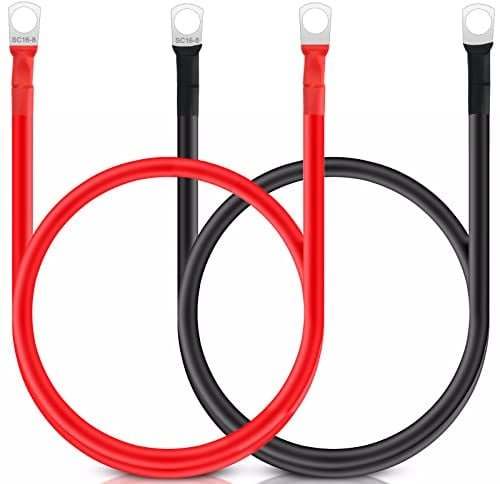 JatilEr · 16 mm² · 50 cm · M8Red/black copper cable pair with M8 terminals. Only a suitable option if your calculation and the manual permit 16 mm² and each one-way run fits within 50 cm.
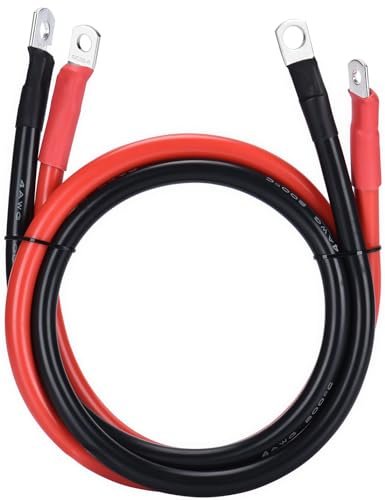 DIHOOL · 25 mm² · 50 cm · M8Exact 25 mm²/4 AWG, 50 cm variant. Use only if your calculation, current-carrying capacity and manual permit 25 mm².
 DIHOOL · 35 mm² · 50 cm · M835 mm²/2 AWG variant with M8 terminals. Check length, connection size and equipment requirements before buying.
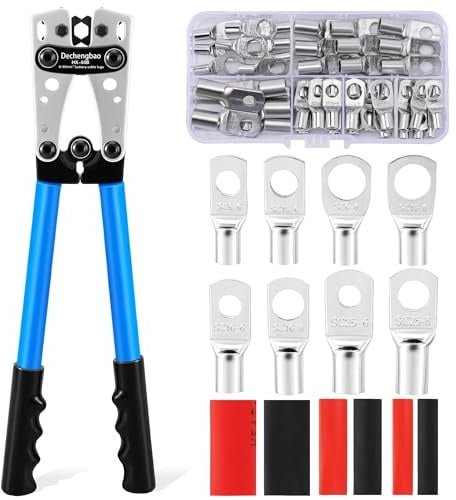 HX-50B · crimping tool 6–50 mm²Hand tool for battery cable lugs in typical camper cable sizes. Check that crimping die and lug match the exact cable.
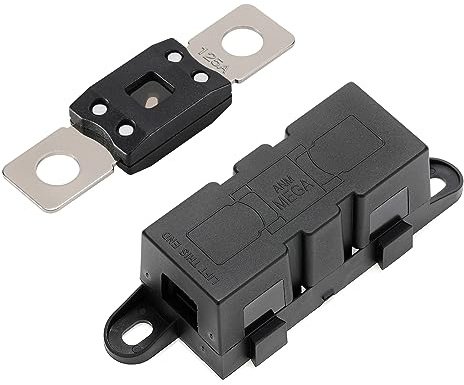 VEXUNGA · MEGA/ANM fuse holder · 125 AMEGA/ANM format reference with exact ASIN. Do not default to 125 A: the fuse rating must be based on the conductor, load and equipment manual.
The formula uses approximate copper resistivity of 0.0175 Ω·mm²/m at a reference temperature. It does not automatically model heating, grouping, insulation, terminals or added resistance from fuses, shunts and connections.